< 일러스트 OpenAI의 DALL·E 제공 >
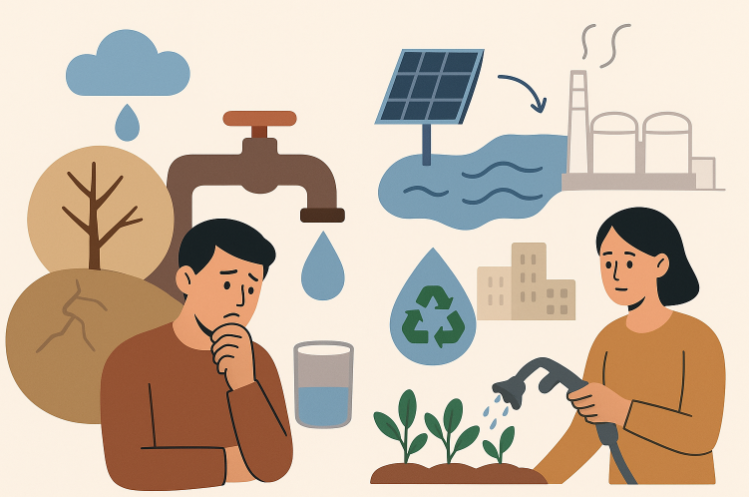
[객원 에디터 10기 / 김시헌 기자] In the summer of 2025, Gangwon faced a colossal danger due to water shortage, indirectly showing that water is not unlimited. After reservoirs dropped significantly, emergency deliveries were needed, and residents faced restrictions on daily use. This crisis was a wake-up call for the world, demonstrating that even countries once considered water-rich can face serious shortages. Water scarcity is no longer just a problem for arid regions. Climate change, population growth, pollution, and aging infrastructure are restricting freshwater supplies around the world. Although rivers flow and oceans surround the world, water shortage is not about the existence of water but about the need for innovation and awareness. It reminds us that water security is as much about management and policy as it is about natural resources.
Around the world, nations are responding with a mix of technology and innovation. Desalination, once limited to the Middle East, has expanded to Asia, Europe, and beyond. Modern plants, often powered by renewable energy, convert seawater into drinkable freshwater. While it still requires a colossal amount of energy and funding, desalination provides a crucial solution when natural water sources can no longer meet demand. Alongside this, wastewater reuse has gained traction. Singapore and other countries treat and recycle water for irrigation, industrial use, and even drinking. Treating wastewater as a resource rather than waste improves resilience against drought. Furthermore, efficient irrigation methods, such as drip irrigation that delivers water directly to plant roots, significantly reduce waste and evaporation. These technological innovations gradually help address the universal water shortage problem around the world.
However, there is another method that could potentially address the water shortage problem even more effectively than technological innovations: our own actions. Water is more than a utility, as it underpins health, food production, energy, and economies. Protecting and valuing water requires more than technology; it requires everyday actions, from conserving water at home to using it efficiently in agriculture and industry. Small changes can make a significant difference and sometimes can have as much impact as large-scale innovations.
We are entering what many experts call a water-shortage era. With the global population expected to approach ten billion by 2050, demand for freshwater will far outpace supply if decisive action is not taken. Desalination, wastewater reuse, and efficient farming practices are essential tools; however, they must be paired with a cultural shift toward valuing water as a finite and vital resource. Education and public awareness campaigns, along with government incentives for conservation, will be key to creating this cultural shift.