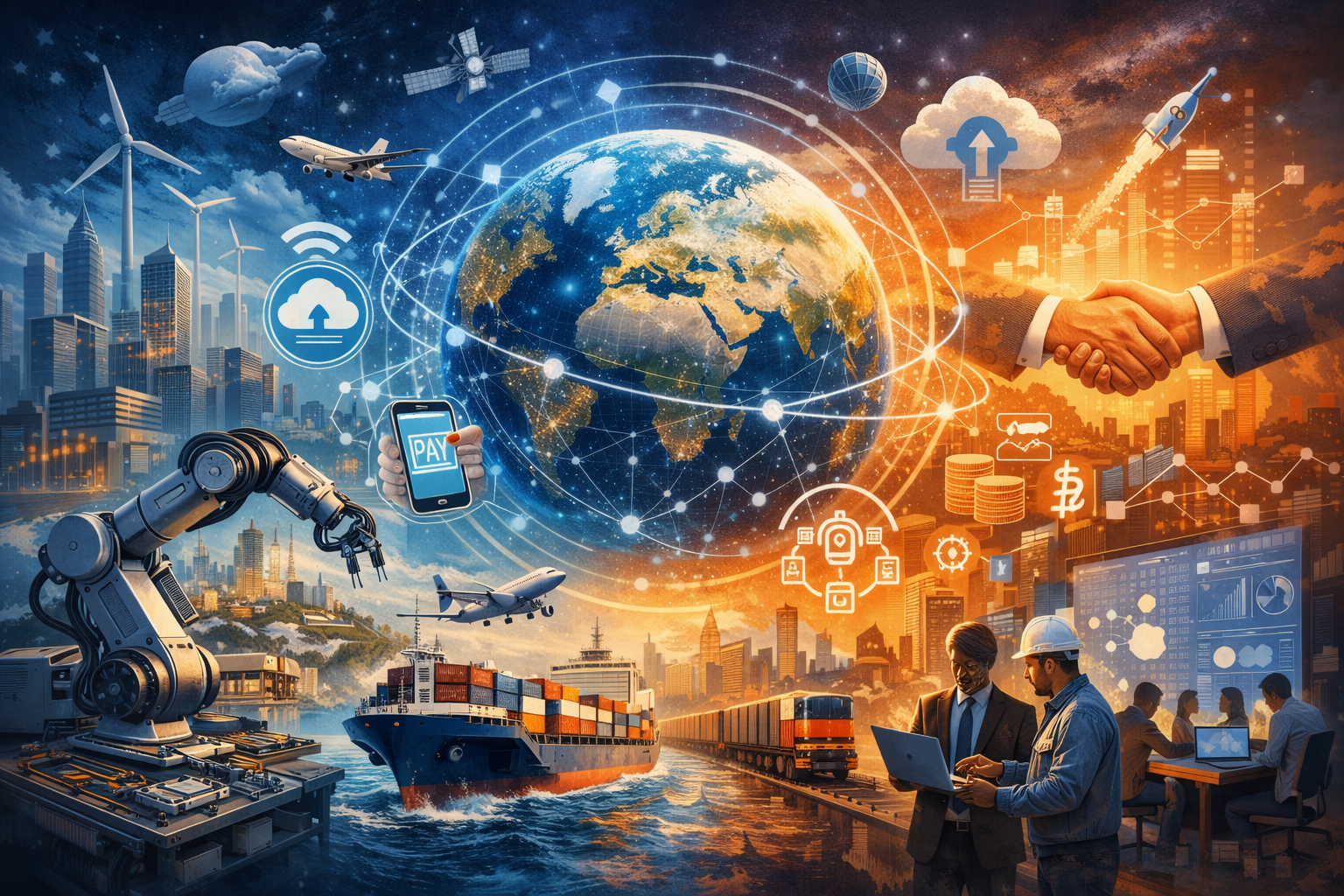
<일러스트: OpenAI DALLE 제공>
Technology’s connection with Globalization
[객원 에디터 11기 / 김예슬 기자] The world has a long history of division. It encompasses a wide range of ethnicities, nations, societies, and more. On a larger scale, continents and countries have been divided by borders. Domestic rules within one country often do not apply to neighboring countries. Take the United States as an example; it consists of 50 different states with different ideas and systems regarding how they function. Yet, since the 1980s, economic, political, and social changes have contributed to a more interdependent world. Globalization is rooted in the idea of such an interdependent world. It involves firms, organizations, and businesses working internationally, offering opportunities for people and countries to communicate, work, and trade across borders. Globalization creates a special bond across the globe between organizations, countries, and continents.
Today, new technologies act as both a driving force and an enabling factor for globalization. Namely, “the characteristic features of international economic transactions have changed considerably, mainly because of the emergence of new technologies, which enabled as well as compelled the shift towards globalization.” In the past, agents from countries had to physically visit other countries to conduct trade. Now, however, methods such as intra-firm trade and inter-firm trade across borders have become widespread. Through technological advancement, transactions—such as design, part movement, and assembly—occur in different locations within the same company, often with reduced labor and transportation requirements. This creates an “internationally integrated production network.” Moreover, flows of foreign direct investment facilitate the geographical spread of both location and ownership of enterprises across countries. As more countries participate in the world economy, more relationships are built that contribute to globalization. These developments are directly linked to the diffusion and transfer of technology to developing countries.
Different Forms of Technology
Technology is advancing at a rapid pace. Few predicted that technology would come this far and accomplish what once seemed unfeasible. Innovations have continuously been discovered and pursued up to the present day. With this trend, technology has become a highly demanded resource and is used across various aspects of society. It even influences how governments design and implement trade and investment policies and programs and, “in so doing, how they interact with firms, individuals, and each other.” According to Chen and Martincus, there are three distinct functions of digital technologies that are particularly relevant to trade. Each expands markets and promotes globalization.
The first category includes online trade platforms, such as digital payments, database systems, ranking algorithms, and chatbots. These platforms lower search, communication, and transaction costs and expand market access. Chen and Martincus (n.d.) state that “online trade platforms raise total exports for small and medium-sized businesses, especially at the product and buyer margins.” These technologies mitigate the drawbacks of cross-border trade by reducing bureaucratic burdens, speeding up trade procedures, and integrating various trade-related agencies. They help small and underdeveloped exporters gain access to global markets, contributing to the globalization of trade and more inclusive global economic participation.
The second category plays a vital role in production costs. For example, routine tasks previously performed by human labor can be replaced by robots that are faster and more productive. “By making services available on demand via pay-as-you-go subscriptions and access from locations around the world, cloud computing transforms IT input costs from large, centralized sunk costs into variable costs.”
The third category, arguably the most directly related to globalization, centers on financial innovations. Trade finance efficiency is increased by reducing the cost and time required to facilitate trade that depends on third-party lending or insurance. Significant amounts of money are saved through this process.
Positive Correlation Between Technology and Globalization: Developing Countries
As technology advances rapidly, it creates opportunities for countries with sufficient pools of scientifically and technically trained workers to accelerate their pace of industrialization. Technology has become more tangible and accessible than before, as it does not require extensive industrial experience or massive capital investments as in earlier periods. Thus, “technology has become a key factor of competitive advantage for both nations and firms.” This evolution has shifted patterns of technology transfer and has implications for technological capability building, particularly in developing countries. “Knowledge networks—both within global firms and across organizations—facilitate the diffusion of technologies beyond traditional centers and support global cooperation to innovate.” Through these networks and diffusion mechanisms, technological capabilities can spread, potentially allowing “latecomer” countries to build capacity even without a heavy industrial legacy.
Challenges and Inequalities in Technology
Despite these benefits, significant challenges remain. One of the primary challenges is entry barriers. Not all countries benefit equally, as barriers to technological access create substantial difficulties. Moreover, the technological capability gap has become a central issue: countries with scientific and technical human capital, along with enabling institutional conditions, are able to absorb and adapt new technologies, while others risk marginalization. Overall, the success of technological globalization depends on internal capacity and the ability to absorb, adapt, and deploy technologies effectively.