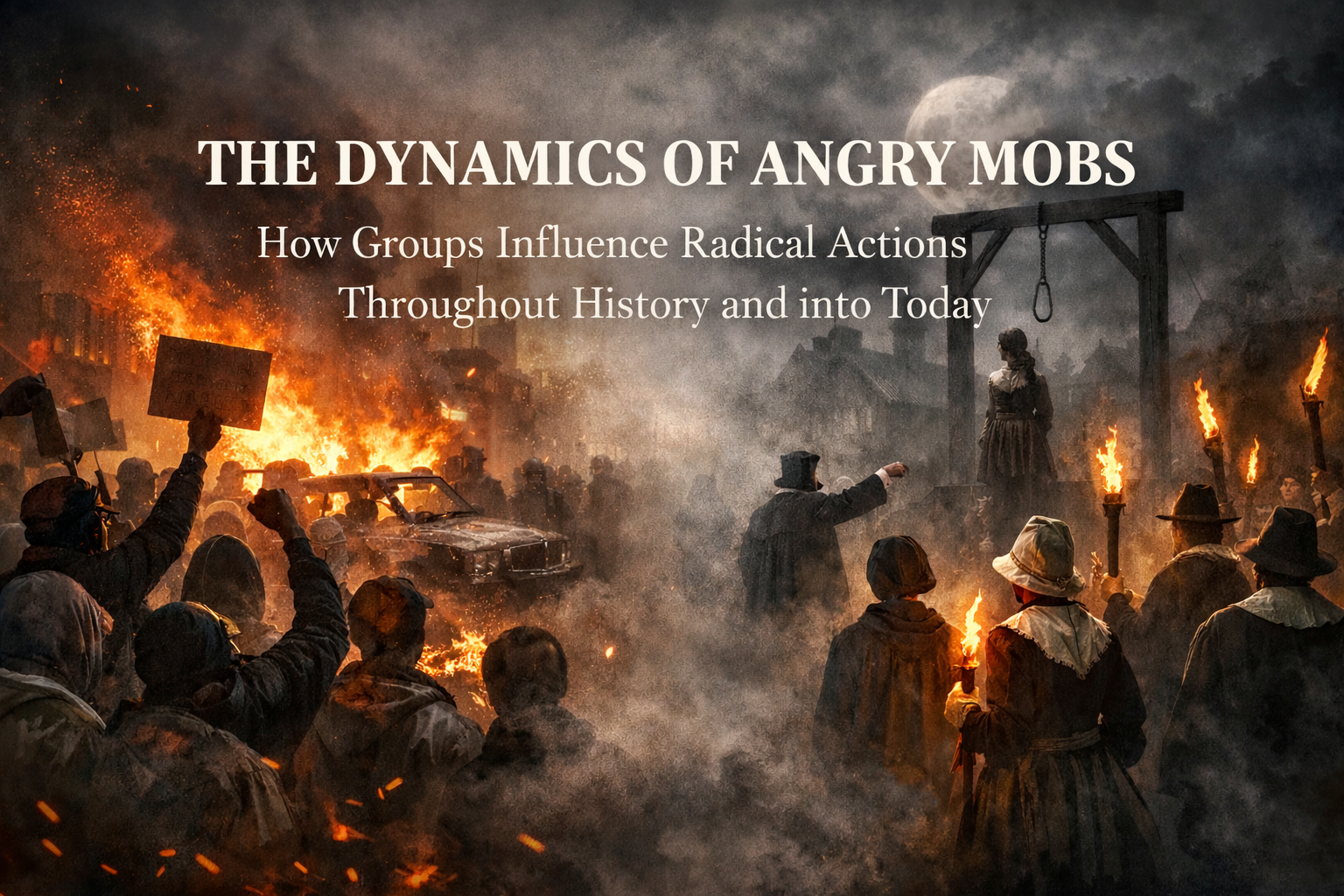
In the eye of history: Salem witch trials.
< 일러스트 OpenAI의 DALL·E 제공 >
[객원 에디터 11기 / 김예슬 기자] The Salem Witch Trials of the Puritan era resulted in over 20 executions and more than 150 imprisonments of women out of fear and vengeance. The entire town contributed to the court statements and tense atmosphere of this watershed moment, making it a collective phenomenon rather than an individual one. The dynamics of the Salem Witch Trials reveal a pattern in human behavior: radical actions often stem from groups rather than isolated individuals. Today, although not as extreme as witch hunts, protests and riots organized by mobs of people in streets, online, and in other environments are commonplace.
Why, however, are radical actions typically led by assemblies and rarely by an individual acting alone? Simple as the question sounds, it has a sophisticated answer supported by philosophical and psychological mechanisms. That is to say, the foundation lies in the fact that large groups of people often act and think differently from individuals alone. All in all, this article will examine these processes, exploring how mobs differ in diversity and boldness and how this connects with the radical actions they often take.
To begin with, diversity and uniqueness are often muted, or rarely seen, within communities of people. This phenomenon stems from the tendency toward conformity: the adjustment of beliefs to align with group norms or expectations. Individuals may side with the majority despite their own beliefs in order to create a sense of unity or, as mentioned earlier, conformity. This phenomenon is called groupthink. An article published by Internet Archive defines groupthink as a phenomenon that occurs within a group in the pursuit of harmony that results in irrational or dysfunctional decision-making.
In this context, peer pressure also plays a role in unity within groups. Desiring to fit in and create a sense of peace, as mentioned earlier, people melt into the “group thought.” They are easily swayed by what others say and believe, adjusting themselves accordingly. A study conducted by Sage Journal supports this claim through an experiment involving adolescents. Researchers noted that peer pressure and the desire to fit in with peers often guide teenagers to adopt certain digital communication practices. Specifically, within their groups, teenagers are motivated—or rather pressured—into communicating via IM, as it is a normative behavior within the group. The factor of peer pressure further amplifies the tendency toward conformity and group thought. Thus, this principle of unity and peace hinders diversity by discouraging people from expressing unorthodox views for fear of creating discord and because of the weight of peer pressure.
Moreover, groups with strong cohesion, commonly resulting from groupthink, tend to be more outgoing and bold in their collective actions. If an individual were left alone to express their opinion, would there be the same effect and extremity? This question forms the basis of “deindividuation.” Deindividuation refers to a psychological state in which individuals lose their sense of personal identity within a group. According to an article published in Cogent Psychology, it occurs when individuals no longer perceive themselves as distinct from others. These feelings lead to a reduction of inner restraints, which may result in the expression of suppressed behaviors.
Individuals in a crowd are guided by a “mental unity and collective soul that makes individuals feel, think, and act differently than they would independently.” Whether at parties, consuming more drinks and substances than usual, or in riots among crowds of football fans, this “collective soul” drives actions beyond the normal standards set by society. In this milieu, groups are more likely to engage in fierce and abnormal actions together than individuals acting alone.