<일러스트 OpenAI DALLE 제공>
Should parents limit their children’s social media?
[객원 에디터 10기 / 김예슬 기자] As technology advances, teenagers’ vulnerability increases accordingly. The more accessible technology becomes, the more teenagers can use it. Namely, social media grabs the attention of many teenagers in contemporary times. The average screen time for teenagers ranges from 7.5 to 9 hours a day. Of these hours, about 5 are spent on social media platforms. It offers dopamine and pleasure elements that make it hard to resist, especially for adolescents who aren’t able to set boundaries around their screen use. Teenagers aren’t mature enough to control their reactions to ephemeral pleasures; they are in a constant search for dopamine. In severe cases, these behaviors build up to addictions, and numbers around the globe substantiate the large number of teenagers glued to their screens.
Concerned about their attitudes, the parents try to restrict this pattern. They react to this pleasure-seeking behaviour by wanting to ban it all — from no social media to even banning video games. Although it is vital to keep boundaries and set limits on social media, “adolescence is an important time of building skills and confidence with managing one’s own interests and time. Too much restriction can limit abilities to build strength in these areas.”
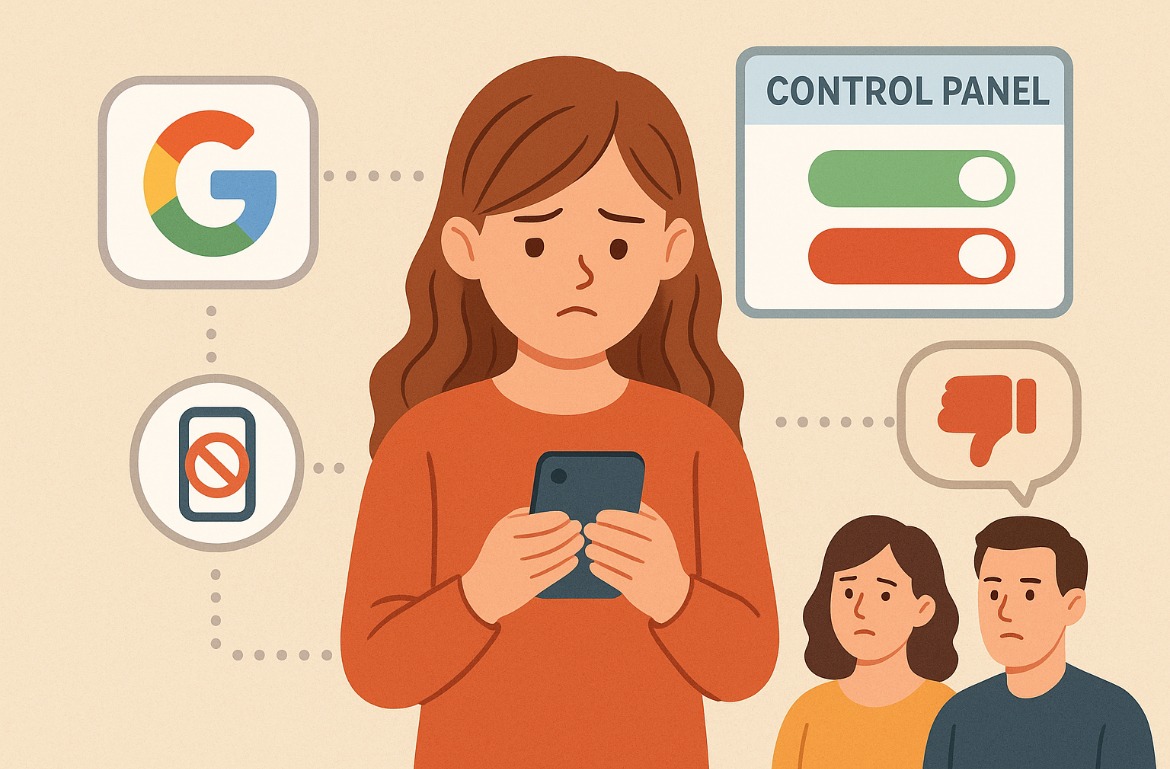
Social media platforms are beginning to respond to these concerns by implementing limiting features, namely time limits. Some limits restrict those under 18 to one hour per day. A plethora of apps have been designed for these purposes to give parents control of their child’s screen time. Opal and Google Family Link are two of the renowned apps that are used by multiple parents and guardians. Parents have voiced varying opinions. Many view them as helpful tools for enforcing limits and reducing distractions, while others find them ineffective and annoying. Yet, these apps lead parents a step toward control and management of their teenagers. It can be hoped that more advancements on these platforms will take place in the near future.
But, are these limits effective in play? What change does it bring to the teenagers?
In a college study, students were put into one of three groups: Control group, who could use social media as they normally do; the Limited use group, who could use social media for only 30 minutes a day; and the limited but active use group, who could use social media for only 30 minutes a day but had to do something active on social media every 3 minutes (APP). Results followed:
“The limited use group with a 30-minute time limit had less depression symptoms than the control group. However, students in the limited use group who described themselves as highly active on social media reported more loneliness, anxiety, and lower self-esteem. This suggests that for those who do not post or comment as often or use social media to browse, limiting their use might reduce feelings of sadness. However, setting a limit might be harmful for those who are naturally active on social media” (APP).
Hence, controlling screen time doesn’t always produce positive effects. It isn’t the only way toward limitations.
Thus, the parents should deploy these limits fitting to their children’s personality and social tendencies. It isn’t wise to leave children lost in this world full of uncontrolled data, but having such a stringent method may bring unintended results, according to APP.
However, instead of fulfilling one’s dopamine with doom-scrolling and on phones, it may be good to spend time outdoors, go on a run, or walk with friends in nature. These activities wouldn’t cause any problems or worries for parents or teenagers’ health.